Search

Windsbird: Footprints around the world

Hong Kong edition

Category

Travelogues

Conversations in Madaba: “If I was much younger, I do you”

Today’s plan was rather an ambitious one, covering Madaba, Mt. Nebo and Bethany-Beyond-Jordan, all of which an hour’s distance away from each other. The public transport only operates between Amman and Madaba, so I was expecting to spend a hefty amount of my budget on taxis.

The first stop was Madaba, famous for it’s Byzantine mosaics. It felt a bit too small to be called a city, but still had the energy and vibrancy that I much preferred than the hectic Amman. The town of Madaba was once a Moabite border city, mentioned in the Bible in Numbers 21:30 and Joshua 13:9. It also has the largest Christian community in Jordan, and I could see many women walking on the streets without wearing a headscarf.

I decided to follow the walking tour of the town suggested in my Lonely Planet travel book which should last about  3 hours, which would give me plenty of time to visit other biblical sites near Madaba.


After making a brief stop to watch a sand bottle being made, I started walking along what is known as the Tourist Street, filled with souvenir shops for tourists. Every single shop I pass by, the shop keepers tried to lure me into their shops, all of which I politely refused and walked on…until I reached a spacious shop called ‘Peace’ which seemed to deal with more high-end products. A man came out and greeted me with a big friendly smile, and to my surprise, a couple of young men nearby greeted me in Korean! He invited me for Bedouin tea and I could not refuse it.

His name was Menwer, and he used to work at the airport in catering. The shop he was working now was owned by his nephew.

It must have been a low-season for Madaba at this time of the year, as there were hardly any tourists in the town, which meant I could ask him as many questions about Jordan as I liked without having to worry about me disrupting his business.

Menwer at the 'Peace' shop

Conversing with someone from different culture and language can be an amusing experience, with interesting metaphors and unusual figures of speech.

“Are you married?”, he asks me.

“No.”

“Do you have a boyfriend?”

“No.”

“Oh! Why not marry?? If I was much, much younger, I do you!”


I ask him around what age Jordanian girls get married, and he answers that it’s around 20 to 23.

“It seems so young!” I say.

“Women are like apples. When they are young, when ripe, they are nice and delicious. When the time goes, not so good. You have to have them when they are good”, and he makes a ‘yuck’ face.

I scream at him jokingly and we both laugh, and do a high five.


Spending time with Menwer set me back against my schedule, so I hurried through my walking tour. All key sites were very small and not very time consuming, but I got lost a few times with my pretty much non-existent navigating skills.

There were many taxis on the main street of Madaba but I decided to go back to Menwer to arrange a taxi for me. I felt I could get a more trustworthy taxi fare if it was through him.  Next stop, Mt. Nebo.
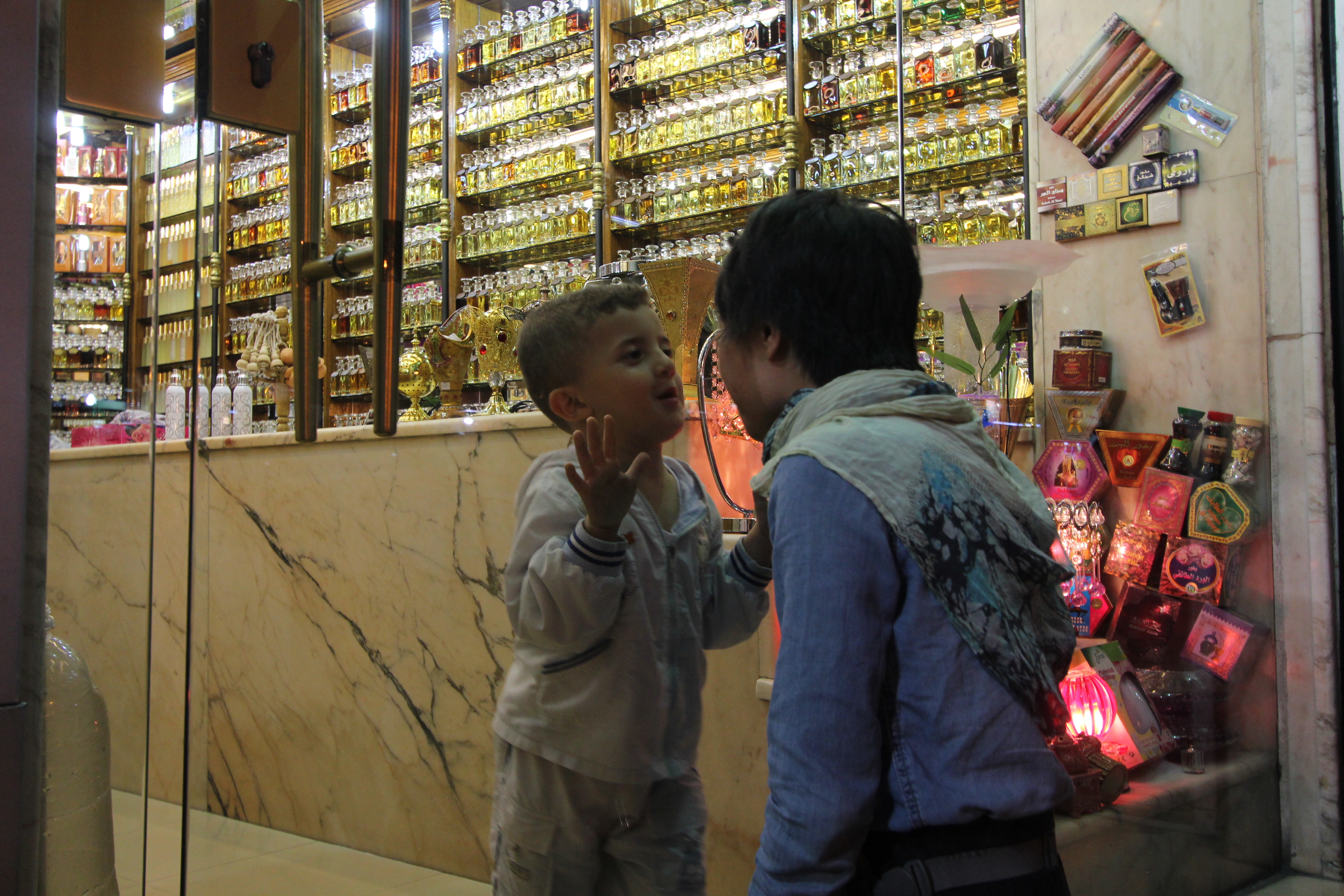


‘The Crazy Girl’

IMG_1598The hostel I book is located on the first floor of a building, and as I reach the staircase a man out of nowhere appears and helps me up with the luggage. As he walks behind me, I keep glancing back, paranoid that he may run off with my bag – unbeknown to me that he would later become one of those people that I find the hardest to say goodbye to in Jordan.

My dorm has three beds and everything in it has a yellow tinge to it. The window is facing another hotel just about 6 meters opposite from my hostel, and a few men are sitting on the balcony looking into our room.

I’m glad to find another Asian girl in the dorm – a Chinese girl with a boyish haircut. I spend the whole evening with her and am slightly taken back by her VERY carefree attitude. When a few men try to talk to us on the high street, she gives them her middle finger. With a shop assistant she finds cute, she flirts with him outrageously and insists on seeing her outside his work hours, despite him saying no to it rather firmly. In the hotel lounge she sits with her feet up on the sofa and legs wide open. When a female staff whispers to her that it maybe better to sit in another position, she just doesn’t get why she should. Back in our dorm, she roams around our room just in a T-shirt and her knickers. It’s all fine between us girls, but the problem is, the window is still wide open and the men on the balcony are still looking in – with a lot more intensity, naturally.

‘Perhaps she isn’t so informed of the Muslim culture here’, I think to myself. Her eccentricity has earned her a nickname of ‘The Crazy Girl’ among the people at the hostel, and I continued to meet other travellers who had stories to tell of this girl in other parts of Jordan.

DAY 1: Wednesday, 18 Sept 2013

Amman

Flickr: http://www.flickr.com/photos/104035608@N03/

First day in Amman

IMG_1653


After landing at the Queen Alia International Airport in Jordan I take a bus towards downtown Amman.  I had to wait for about 40 minutes for it to take off, but the bus fare only costs 3.250 JD whereas a taxi costs about 20 JD.

I get off at 7th circle as advised by the information desk at the airport, but it turns out to be an incorrect advice as I end up taking a taxi into downtown anyway.

The roads here are absolutely hectic. There are no lanes and cars honk all the time, not as a sign of aggressiveness but simply to let others know of their presence to minimise any crashes or accidents.

The young taxi driver and I chat easily during our 30 minute drive, but when I hand him 10 JD note at arrival, he claims he does not have any change on him and insist I just give him 10 JD. I find it hard to believe that he doesn’t have any change on him, and I remind him that we agreed on 7 JD. I handed him a 5 JD note and all the coins I have in my purse which comes up to the total of 6.750 JD, but he is still pissed off at me.  I don’t like how his smiles quickly turn sour at the mere 750 fils.

My hotel is just a few meters across the street from where I got off the taxi, but it takes ages for me to cross. I’m too scared of the unruly traffic and they don’t show any sign of stopping just for me. The trick is slowly start crossing anyway, and then the drivers will stop, but this is something I learn a few days later.

I’m annoyed, tired, and feel intimidated by all the stares from locals.  Perhaps choosing to travel in such an unfamiliar country by myself wasn’t such a good idea. I start to dread 11 more days to come.


DAY 1: Wednesday, 18 Sept 2013

Amman

What to do with 12 days

I get 4 days of annual leave at work. And I have to take it at the same time as my boss. It’s the downside of working in journalism in a foreign bureau.

But this year, I managed to extend it to 12 days and I was determined to make the most of it. I was getting so tired of all my goals for the year 2013 being utterly unfulfilled and a distraction wouldn’t hurt.

I sat on the edge of my bed one night and flicked through ‘1000 Ultimate Experiences’ published by Lonely planet, which lists top sites around the world into different categories. ‘Ultimate City Breaks’, ‘Best Places to Experience Music’, ‘Ultimate Sailing Trips’.. I  arrive on the chapter ‘Most Surreal Landscapes’ and google flight prices for each destinations to see which is the cheapest. Jordan it is. Wadi Rum, here I come.


The Edinburgh Fringe Festival: A Romance Review

romance_31621


As we, the audience, enter the small room set with tiers of elevated rows of chairs, we walk into the scene of maidservants in 1600s Korea, busy preparing for the wedding of their beloved mistress and her mother dressing her.

As the bride-to-be picks up a fairytale book to read to her illiterate maids as they get on with their sewing, we also get sucked into this delightful art of storytelling using Korean traditional music, percussion and shadows on the wall. The love story of the book and the personal history of each women in the room are interwoven delicately and seamlessly, and the brilliance of the cast switching from one character to the next is a joy to watch.

Apart from having to move your eyes constantly from the subtitle on the left wall to the stage area in order to understand the narrative, it is a beautiful piece of theatre that I would gladly watch over and over again.

The Edinburgh Festival Fringe: Airnadette Review

airnadetteAll I have been told about the show by the press officer is that it is a mime – naturally, I was expecting actors in black costume doing….er… mime.

It is actually a compact version of a jukebox musical, with performers lip synching to snippets from well known films and pop songs the entire show. The result is a  slapstick comedy with a very loose plot of no significance.

Right from the beginning I was struggling to see the appeal of the show, with six all-equally-annoying characters with their stupid, brash not-that-funny jokes. Just as you start to enjoy the song they are singing, they will switch to another. Or play series of quotes from different films so fast that all I am thinking is ‘huh??’

It may work well as a clever skit, but a whole hour of this have been a pure torture.

Vermeer and Music: The Art of Love and Leisure Exhibition Review

971878_10151807454747442_784324501_nAt  the Sainsbury Wing of the National Gallery is my most anticipated exhibition of the year: “Vermeer and Music: The Art of Love and Leisure”.

Based mostly on artworks in its own collection, we are given a glimpse into the 17th century Dutch paintings and the association tied to the period’s popular theme, music.  Alongside it are displayed musical instruments and songbooks of the time, such as harpsichord and violin, as if they have popped out of the paintings themselves.

Room One, ‘Music as Attribute and Allegory’ is mostly of still lifes where music stands as a symbol for transience of life. It also indicates an intellectual status of the sitter of the portrait, someone of a good taste and education.

In Room Two,  ‘Musical Companies and Festive Gatherings’, we see how music was an integral part of Dutch society, with everyone participating in making music in their everyday lives. Music is what brings harmony.

As beautifully captured by Jan Steen’s “A Young Woman Playing a Harpsichord to a Young Man”, Room Three, ‘Intimate Duet’ is all about subtle sensuality music brought and the relationship between characters behind the ‘innocent’ playing of the instruments.

The highlight is, of course, is the final room ‘Vermeer and Solo Musicians’.  It is a little disheartening that there are only five paintings of Johannes Vermeer out of 35 artworks in the exhibition, but nonetheless, having ‘The Guitar Player’, ‘A Young Woman standing at a Virginal’,  and ‘A Young Woman Seated at a Virginal’ displayed on the same wall is just simply paralysingly beautiful.

‘The Guitar Player’ is the most captivating of all – the sense of tranquillity is highlighted by the empty wall on left side of the sitter which takes up almost half of the entire canvas, as if to intensify the sound of the chord which has been just strung on the guitar.

The exhibition ends with a closer look at Vermeer’s techniques, delving into his brush strokes, use of colours and paint thickness. You can also see magnified photographs of fingerprints found in some of his paintings.

Live music is played by the members of the Academy of Ancient Music at  dedicated times, which is a treat to have at the background while looking,  but perhaps not worth queuing for 20 minutes for a seated performance.

Overall, it is a pleasant exhibition that includes artworks by Jan Steen, Peiter de Hooch and Gerardter Broch. Having to pay £7 to see what is mostly already part of the National Gallery’s collection felt like a bit of a rip off, but the five breathtaking paintings by Johannes Vermeer made me content enough.


The exhibition runs until 8 September 2013.


Create a free website or blog at WordPress.com.

Up ↑